Our family business has a long history shaped by tradition and a passion for fresh vegetables. Today, we combine this tradition with modern and sustainable cultivation methods.
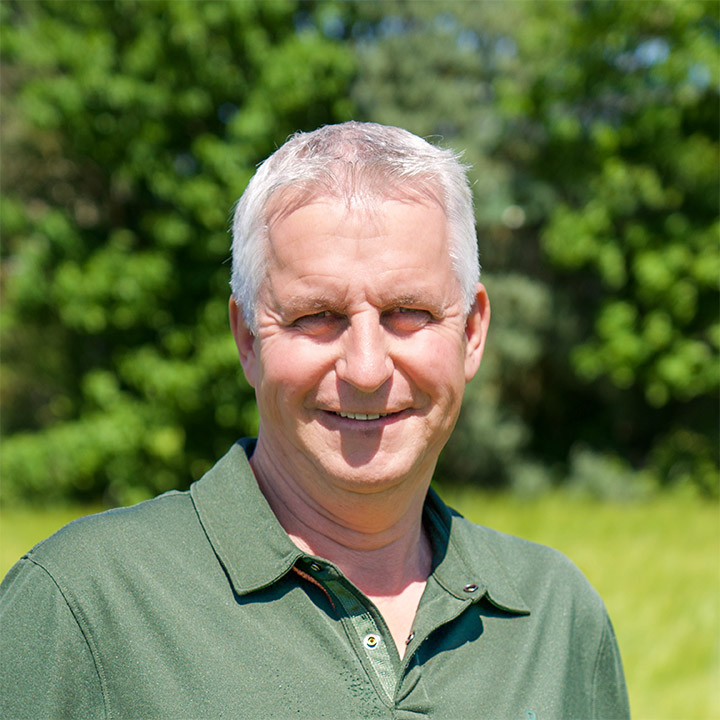
Dirk Beckedorf
However, due to the fragmented field structure and its immediate proximity to the city, there was little opportunity for further development. For this reason, in 2005 we decided to relocate our open-field production to Reinbek (east of Hamburg).
Here, right next to the idyllic Sachsenwald forest, we have found ideal conditions for our cultivation. On fields with light, sandy soil, the vegetables are able to ripen slowly, making them particularly crisp and giving them a full-bodied, intense flavor. All of our fields are consolidated and located in close proximity to our processing facilities. This means that the journey from field to package is kept to a minimum, allowing us to guarantee our vegetables at peak freshness.
Have we sparked your curiosity and would you like to see for yourself how our vegetables are grown and packaged?
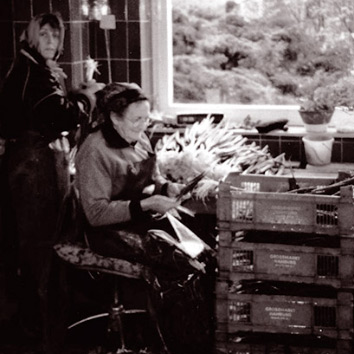
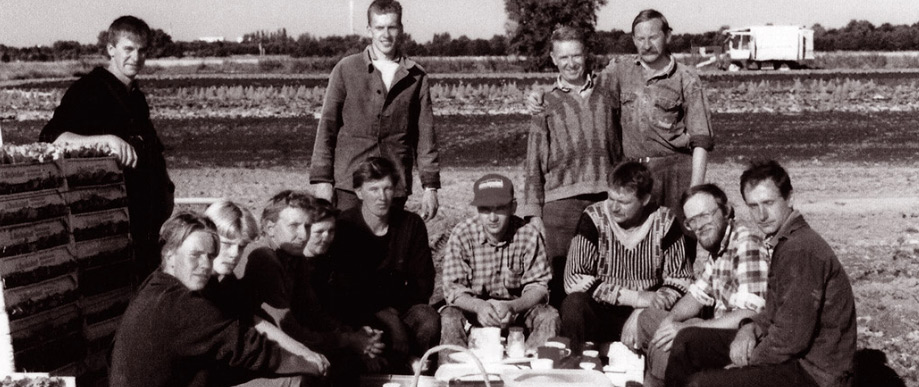
In 1939, Lina and August Schween laid the foundation for our vegetable farm in Moorwerder (Hamburg). From 1962 to 1995, Marianne and Jonny Beckedorf ran the business as the second generation. In 1995, Kathrin and Dirk Beckedorf took over the management of the farm. Ten years later, in 2005, they decided to establish a new open-field production site in Reinbek (Schleswig-Holstein), as the land in Moorwerder had become too limited in size and its proximity to the city no longer allowed for further growth. In 2022, Tietje Beckedorf joined the family business.
For us as a family-run business, tradition is not just something from the past, but lived experience combined with fresh ideas – this is how vegetables of the highest quality are grown, with care and dedication.
A responsible and careful approach to our soil is very important to us. That’s why we rely on innovative, soil-conserving methods such as “Controlled Traffic Farming (CTF)”. This creates the foundation for future generations to continue farming these areas successfully.
Through digital planning, we coordinate our field operations with one another. Since our fields and processing facilities are located close to each other, transport routes are short. We have also created compensation areas with wildflower mixes that are permanently left uncultivated. These areas provide nature with a protected refuge.
On the roofs of our halls, photovoltaic systems generate electricity that we use directly in our operations.
To consistently guarantee the high quality and safety of our food, our farm is subject to continuous quality inspections.
This ensures that we meet the requirements of the QS system for good agricultural practice, particularly in the areas of food safety, hygiene, traceability, and the responsible use of production inputs. In this way, we guarantee that our vegetables are produced in a controlled, safe manner and in accordance with high quality standards. With this certification, we are also authorised to supply products under the GLOBAL G.A.P. system.
Through the additional module “Voluntary Inspection of Labour and Social Conditions”, the implementation of working and social conditions for external workers on our farm is independently assessed on a voluntary basis.
The “Voluntary Sustainability Inspection (FIN)” is also a voluntary, industry-standard inspection system operated by QS Qualität und Sicherheit GmbH.
With this additional module, we are authorised to supply McDonald’s. The specific requirements of McDonald’s are verified through an additional checklist as part of the QS-GAP audits. The module covers eight requirements defined by McDonald’s, including risk minimisation related to nearby livestock operations or composting facilities, field and personnel hygiene, as well as successful participation in the annual McDonald’s GAP training courses followed by an aptitude test.
Mecklenburger Ernte is a fruit and vegetable producers’ organisation based in Mecklenburg-Vorpommern, currently comprising 27 member farms. Our shared goal is the marketing of fresh vegetables and processing fruit – efficiently, reliably, and at the highest quality.
Marketing is primarily carried out via contract marketers, with the end customer in focus: the retail grocery trade. In doing so, we make use of all regional and national sales channels, including export markets, in order to place our products in the best possible way.
For individual questions or specific requests regarding our products or sales, please feel free to contact us personally or get in touch with us.